.jpg) |
| Major Mangroves in 2000 |

In Australia
- Spatial Scale of Mangroves: Australian Mangroves are located along the coast of Australia. Approximately 11,000 km (18%) of Australia’s coast is lined with mangroves. Estimates of Australia’s total area of mangroves ranges from 749,000 to 1,161,700 hectares, which means that Australia has the third largest total area of mangroves in the world, only after Indonesia and Brazil.
 |
| Locations of Mangroves in Australia |
- History: Mangroves, as know by some, have been around for at least 50 million years, possibly longer. For instance, the origins of Avicennia, a genus which include mangroves, have been linked to the opening of the Atlantic Ocean extending back almost 100 million years. Species such like Rhizophora and Avicennia, which are both in the same genus, were widely distributed by 50-55 million years ago. At the time the ancient Tethys Sea, a shallow equatorial seagull of coral reeds and islands, was last closing as the massive continental fragments continued to shift and jostle across the globe. This process of continental drift appears to have played a pivotal role in determining both the diversity and type of mangroves found today, as well as their current global distributions.
 |
| Tethys Sea |
- People's Impact: The Aborigines, who arrived in Australia approximately 40,000 years ago used mangroves as a place to hunt and collect food. Some of the items they collected include shellfish, such as oysters that attach to the mangrove roots, and mud crabs and worms. Although the Aborigines used mangroves as a place to find food, they did not abuse them, which is part of the reason that these mangroves exist today and the present day Aborigines are able to enjoy them as well.
 |
| Aborigines |
- Benefits: However, the Aborigines, especially in the present day are not completely harmless to the mangroves and the areas surrounding them. Once the Aborigines collect the oysters and other shellfish, they typically cook and eat them in areas surrounding the mangroves. Although this action may seem harmless it is not. When these people cook the food, the fires they use release charcoal which accumulates and can eventually cause variations in the nature of the area as well as the shellfish and other food sources. In addition, mangroves have been degraded for some other uses including, development of coastline, erosion of shorelines, increased levels of heavy metals, marine oil pollution from sewage systems and drains, accidental spills during refuelling of vessels in ports, aquaculture, uncontrolled stock access, climate change (which encourages sea level rise), natural disasters, and human usage including garbage dumping as well as stripping the mangroves for parts used in soap making and timber usage.
 |
| Mangroves |
- Preservation: Although mangroves, like many other ecosystems are being destroyed by both human and natural impacts, at an astonishing rate, there are many things that humans can do and are doing to help preserve these delicate areas. Although, worldwide about 35% of mangrove area has been destroyed in the last few decades of the twentieth century, in Australia, there have been efforts implemented to preserve these ecosystems, as “about 18% of Australia’s mangrove forest areas fall under the protection of National Parks and other reserves” (MESA). Some of the ways individuals can help preserve mangroves include implementing fencing along the intertidal zones so that livestock are unable to access and destroy them, designing riverfront structures such as boat ramps that stop or minimize the destruction of mangroves, avoiding physically destroying the areas by not walking, riding, or driving through the mangroves, especially at low tide, disposing of trash, chemicals, and oils in the correct manner in order to avoid substances from polluting the areas, and the easiest way for people to do their part in preserving the areas is by reporting any of these or other harmful activities to the correct authorities.
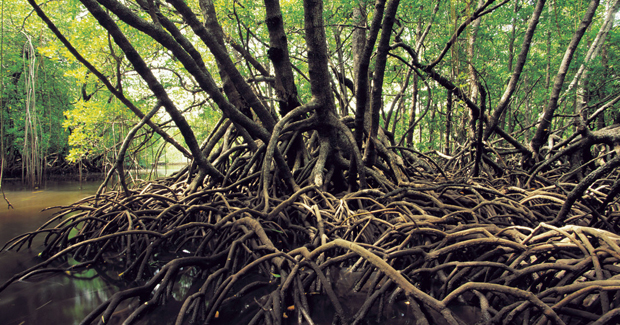 |
| Roots of Mangroves |
- Present: Without the preservation of mangroves the amount of fish would decrease drastically because Mangroves provided habitat for 80% of seafood species. Mangroves also store an exceptional amount of carbon. They are able to store up to 50x more than their terrestrial (tree forest) counterparts. However, coastal development, aquaculture, pollution, and over-harvesting have led to a 30% loss of mangroves globally. Human impacts are reducing the capacity of mangrove ecosystems to withstand other environmental change such as erosion, severe storm activity, or sea level rise.
 |
| Mangroves in Their Habitat |
- Future: In the future there will be a continuing major decrease in the number of miles mangroves cover because of humanity taking them down for agricultural use. Approximately 35% of mangrove area was lost during the last several decades of the 20th century (in countries for which sufficient data exist), which encompass about half of the area of mangroves. The United Nations Environment Program & Hamilton (2013), estimate that shrimp farming causes approximately a quarter of the destruction of mangrove forests. The remaining mangrove forest areas of the world in 2000 was 53,190 square miles (137,760 km²) spanning 118 countries and territories. In the future due to a higher demand in agricultural use of coastal areas, mangrove covered areas will begin to decrease. With this high demand of mangrove areas coastal areas will be begin to be affected with the incoming tides and destructive weather which will harm these areas which were protected by the Mangrove forests.

 |
| Cut Down Mangroves |
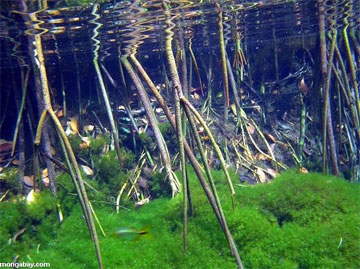 |
| Shrimp in Mangrove Habitat |
References:
Bird, Eric C. F. "Human Interactions with Australian Mangrove Ecosystems." United Nations
University. Web. 1 Dec. 2014.
"Mangrove Forests." Wetlands International. Web. 1 Dec. 2014.
"Mangroves of Australia." Marine Education Society of Australia. Web. 1 Dec. 2014.
MangroveWatch. Web. 1 Dec. 2014.
Mann, Kenneth H. "Mangrove Swamps." Encyclopedia Britannica Online. Encyclopedia
Britannica. Web. 1 Dec. 2014.
Syste, N. "Mangrove Ecology." The Encyclopedia of Earth. Web. 1 Dec. 2014.
Warne, Kennedy. "Mangroves." National Geographic. Web. 1 Dec. 2014.
"What Is a "mangrove" Forest?" National Ocean and Atmospheric Administration. Web. 1 Dec.
2014. <http://oceanservice.noaa.gov/facts/mangroves.html>.
Kavanagh, Etta. "A World Without Mangroves?" Science Mag. AAAS. Web. <http://epic.awi.de/17086/1/Duk2007a.pdf>.

No comments:
Post a Comment